



South Asia
South Asia, a field of rivalry for influence between China and India, continues to experience high levels of intra-state violence in certain areas (Afghanistan, Baluchistan, Jammu and Kashmir).
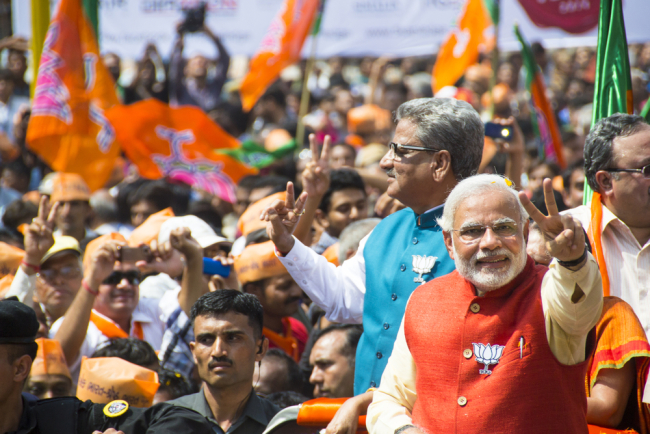
The BJP and State Politics in India: A Crashing Wave? Analyzing the BJP Performance in Five State Elections
In May 2014, the Bharatiya Janata Party (BJP), led by Narendra Modi, decisively won India’s sixteenth General Elections. For the first time in thirty years, a party secured a single majority of seats in the lower house of parliament – the Lok Sabha (282 out of 543) – and for the first time since independence, that party wasn’t the Congress.
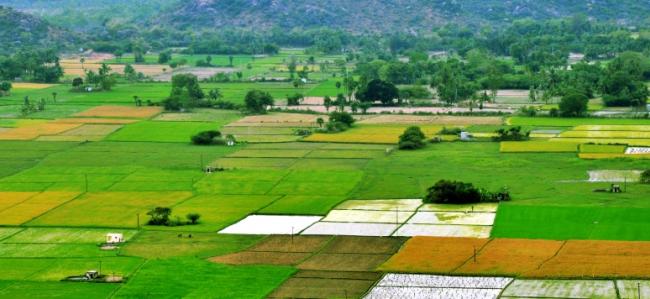
Indian Policies in the Phosphate and Fertiliser Sectors: International and domestic aspects
India is now a major player in the international fertiliser market, regardless of the nutrients considered. Whether it is a question of imports, domestic production, or consumption, India ranks among the top three global players in the sector.

India’s Approach to Climate Negotiations: From the South to the North?
India’s approach to climate negotiations results from the interplay of two distinct logics, an external one and an internal one. While the external logic is derived from quantitative attributes at the aggregate level, such as the overall size of India’s economy, the internal logic is derived from qualitative attributes at the individual level such as per person incomes and productivity. For three decades, from the early 1970s to the early 2000s, India’s internal and external logics overlapped.
Space Collaboration between India and France: Towards a New Era
In the sphere of space research, France-India collaboration began in the early 1960s, with France providing assistance to India’s Rohini sounding rockets programme. Over the years, France has played a constructive role in helping India to develop its ground and space infrastructure, as well as its launching platforms and human resources. In point of fact, France has emerged as one of India’s most dependable partner in the realm of space.
Economics in Narendra Modi’s Foreign Policy
A distinct feature of Prime Minister Narendra Modi’s first year in office was the remarkable speed and alacrity with which he moved on external engagement. During his first twelve months as Prime Minister, he travelled to almost twenty countries in different parts of the world. Indeed, Modi appeared to be guided by the impression that high rates of economic growth cannot be generated only by domestic policies and initiatives.

(Dis)integrating Asia? - Interview with GVC Naidu
GVC Naidu is a Professor of International Relations at the Jawaharlal Nehru University in New Delhi.
Afghanistan’s Difficult Transition
Afghanistan’s transition has been, politically speaking, slower than first expected; militarily, it has been difficult with the Taliban increasing its attacks in many provinces, compromising the possibility of dialogue with the new power; and a diplomatic transition in which partners and neighbors have moved slowly from dialogue to action.
Le rôle de l'Inde de Modi dans la politique américaine en Asie
As President Obama makes an official visit to India, Martin Quencez, expert from the GMF Paris office reflects on the current administration's policy toward Asia and notably the "pivot to Asia". The celebrated Indo-American relationship does not appear to have held much promise until now. Could it grow significantly during Narenda Modi's presidency to constitute a key element of the American presence in the region?
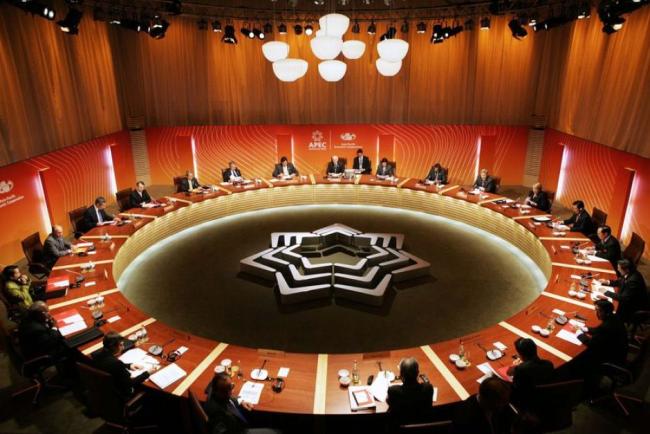
The Asian Century: What International Norms and Practices? Conference Proceedings, 12 September 2014
Asia is now a nerve center for global economic activity and a theatre of some of the most pressing security concerns of our time. So important has Asia become to global affairs today, and ostensibly for the decades to come, that many have already dubbed the 21st Century as the “Asian Century”.
Narendra Modi’s India
The Indian People’s Party (BJP) coming to power in the 2014 legislative elections raises many questions about the country’s governance.
ASEAN-India Political Cooperation: How to reinforce a much-needed pillar?
India is one of Southeast Asia’s principal neighbors and there is certainly great potential for cooperation with the region and its institutional representation, ASEAN. But does India properly exploit this opportunity? Is Southeast Asia satisfied with the level of engagement?
Post-War Sri Lanka: Roads to Reconciliation
The Center for Asian Studies of the French Institute of International Relations (Ifri) organized on 9 December 2011 a round table discussion regarding the future of the ongoing reconciliation process in Sri Lanka, entitled ‘Post-War Sri Lanka: Roads to Reconciliation'.
From 'Looking' to Engaging: India and East Asia
The Look East policy (LEP), launched in the early 1990s, was intended to engage India more closely with the East Asian region, but it met with only limited success initially, for India was not seen to be a major contributor either to regional security or economic development.
Reassessing the Role of the Media in Pakistan
Despite spells of authoritarianism, Pakistan's rulers have never fully been able to subdue the media. In a world where the constant flow of information defies borders, such an endeavor becomes even more difficult.
China-India Relations: Strategic Engagement and Challenges
Sino-Indian relations have become increasingly significant and produced widespread implications. The evolving bilateral relationship is reasonably seen as a result of their shifting strategies and the ever-changing global politico-economic situation. On the political front, high-level interaction plays an important role in improving Sino-Indian ties. The political willingness to improve relations helps kick-start the significant process of building confidence and trust in different areas and at various levels.
Fiscal Deficit, Crowding Out, and the Sustainability of Economic Growth: The Case of the Indian Economy
This study examines the long-run relationship between the fiscal deficit, the crowding out of private capital formation and net exports for the Indian economy during the period from 1980-81 to 2008-09.
A Shadow over the Himalayas: India's Tibet Problem
This article explains the central role of the Tibetan issue in complicating Sino-Indian relations.
Hospital Chains in India: The Coming of Age?
In many countries, the provision of hospital care is turning into an industry with the increasing presence of large corporate hospital chains. Along with public agencies and small private operators, corporations are now investing in the Indian hospital sector.
Since the 1980s, health sector reforms and the liberalization policy in India have created new profit-making opportunities in the health care market for local and international corporations. A new pro-market regulatory environment has helped private corporations to invest in the hospital sector.
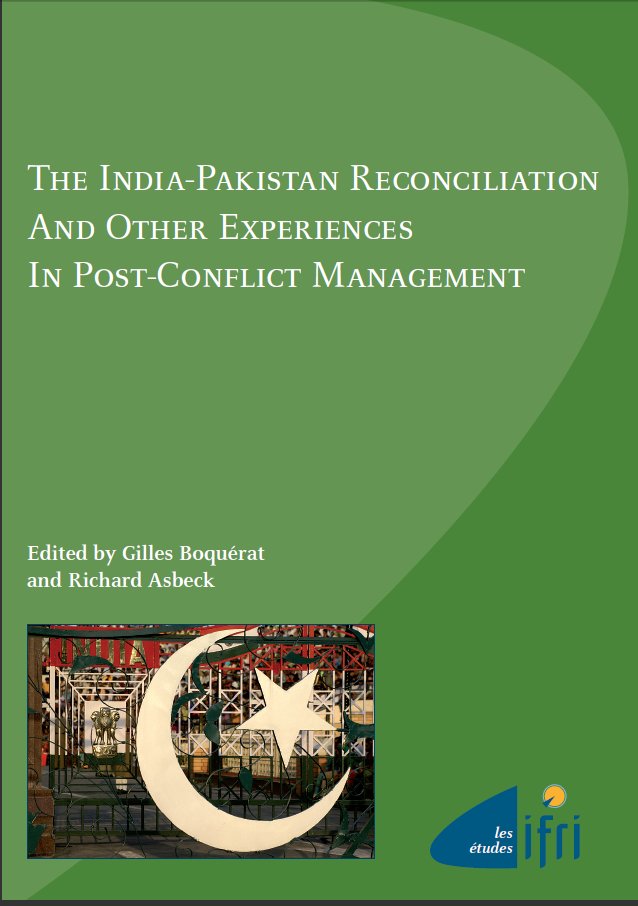
The India-Pakistan Reconciliation and Other Experiences in Post-Conflict Management
Since the November 2008 attacks in Mumbai, the India-Pakistan dialogue has been at a standstill. Through analysis from German, French, Indian and Pakistani authors and in reference to other reconciliation processes between counties with a long history of hostility, this work explores the paths likely to favor a sustainable rapprochement between the two nuclear powers of South Asia.
Breaking New Ground: Congress and Welfarism in India
Social welfarism played a decisive role in giving substance to the inclusive policies of the Congress government and the results of 2009 elections show that voters have given a mandate for the continuation of such welfare-oriented policies. This paper tracks the processes that paved the way for a radical shift leading to the adoption of a wide range of policies that reflect a social democratic flavour.
Ifri, a foundation recognized as being of public utility, relies largely on private donors – companies and individuals – to guarantee its sustainability and intellectual independence. Through their funding, donors help maintain the Institute's position among the world's leading think tanks. By benefiting from an internationally recognized network and expertise, donors refine their understanding of geopolitical risk and its consequences on global politics and the economy. In 2026, Ifri partners with over 90 French and international companies and organizations.

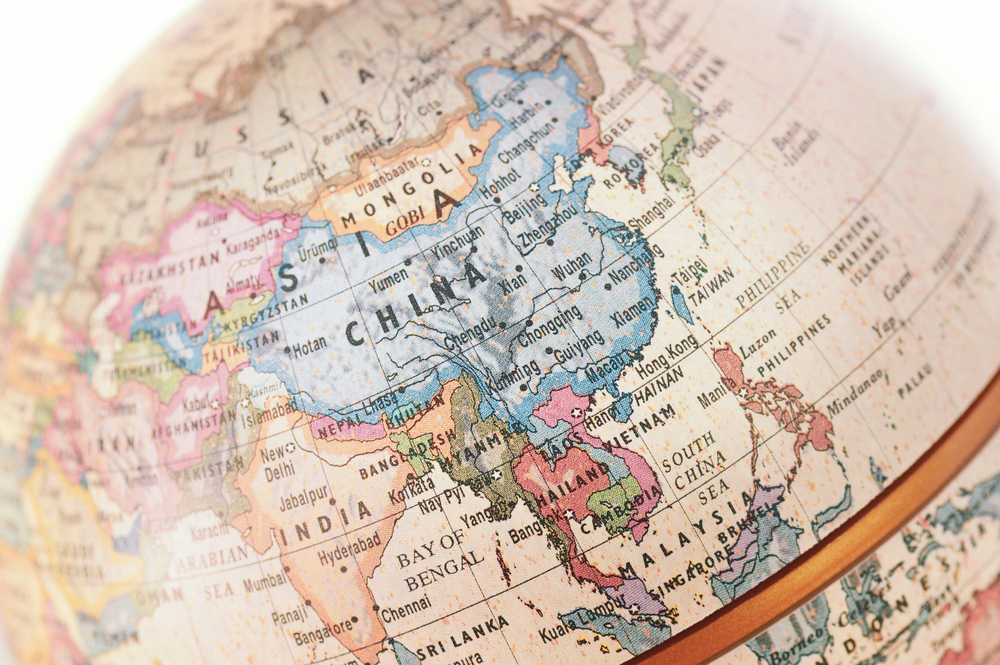
Center for Asian Studies
Asia is a nerve center for multiple global economic, political and security challenges. The Center for Asian Studies provides documented expertise and a platform for discussion on Asian issues to accompany decision makers and explain and contextualize developments in the region for the sake of a larger public dialogue.
The Center's research is organized along two major axes: relations between Asia's major powers and the rest of the world; and internal economic and social dynamics of Asian countries. The Center's research focuses primarily on China, Japan, India, Taiwan and the Indo-Pacific, but also covers Southeast Asia, the Korean peninsula and the Pacific Islands.
The Centre for Asian Studies maintains close institutional links with counterpart research institutes in Europe and Asia, and its researchers regularly carry out fieldwork in the region.
The Center organizes closed-door roundtables, expert-level seminars and a number of public events, including an Annual Conference, that welcome experts from Asia, Europe and the United States. The work of Center’s researchers, as well as that of their partners, is regularly published in the Center’s electronic journal Asie.Visions.