


The BJP and State Politics in India: A Crashing Wave? Analyzing the BJP Performance in Five State Elections
Asie.Visions, No. 80, December 2015
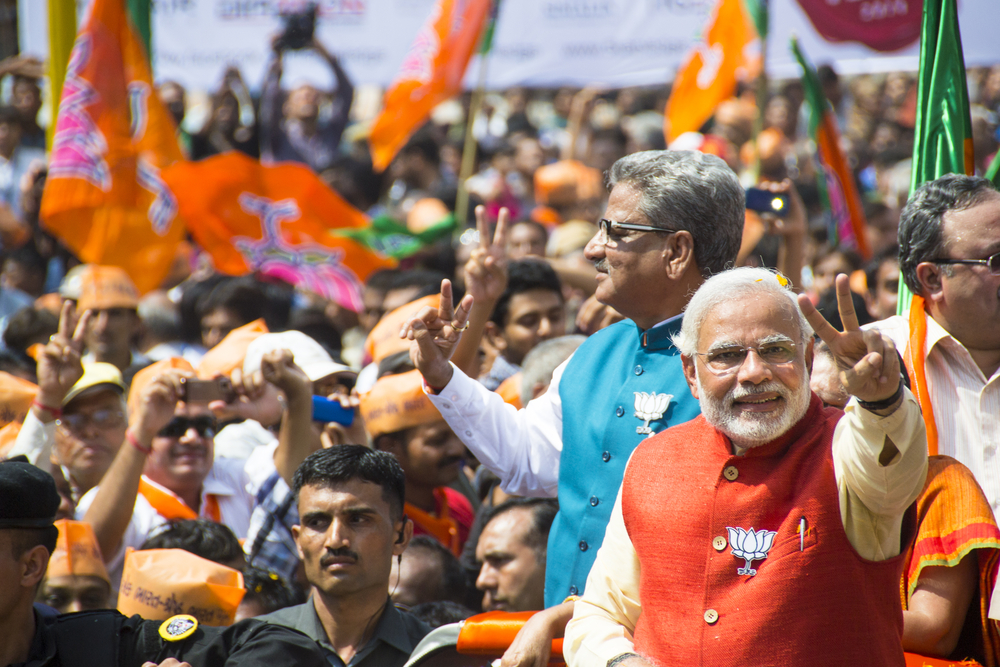
In May 2014, the Bharatiya Janata Party (BJP), led by Narendra Modi, decisively won India’s sixteenth General Elections. For the first time in thirty years, a party secured a single majority of seats in the lower house of parliament – the Lok Sabha (282 out of 543) – and for the first time since independence, that party wasn’t the Congress.
In the year that followed, the BJP successfully contested four state elections, in the states of Haryana and Jharkhand in October 2014, and in Maharashtra and Jammu & Kashmir in December 2014. It formed the government in the first three states and had to concede power to a regional party in the latter, despite a near clean-sweep in the region of Jammu.
The BJP’s performance in the four state elections of 2014 bore remarkable resemblance to the previous General Elections. Its vote share surged everywhere, including in states where it had a weak presence. The surge in vote share credits the notion of a pro-BJP wave. Available survey data suggests that the party succeeded in consolidating its traditional support among the upper castes with support from voters from most segments of the electorate, except Muslims. Recent work also suggests that the BJP’s victory partly relied on its capacity to attract new voters, particularly among the youth (Heath, 2015), and on its capacity to mobilize record numbers of voters in cities.
Calling these results a triumph for the BJP would be an exaggeration, however. As in 2014, the party benefited for the disproportionality effect of the electoral system. The combination of a First-past-the-post majority electoral system with a fragmented political landscape means that the distribution of votes among parties determines the conversion of votes into seats for the winner. The more dispersed the vote, the more disproportionate the conversion into seats.
In fact, the BJP’s performance everywhere remains more or less in the bracket of 30% of the vote share. This serves as a reminder that there remains a large majority of voters that does not opt for the BJP but disperses its votes between various other parties. Moreover, the electoral cartography of the BJP’s performance reveals that its victories are often limited to specific areas, or sub regions within states. This shows that the BJP still struggles to develop a “pan-state” presence.
This series of victories brutally stopped with the Delhi state elections, held in January 2015, where the Aam Admi Party (AAP – Party of the Common Man) – a two-year old party that had emerged from the 2011 anti-corruption movement – won all but three of the 70 seats of the State Assembly. The Delhi elections made the demonstration that the BJP could be defeated in a bipolar fight, and in a campaign that was fought on the terrain of development, on which it is supposed to have a competitive advantage. Politically speaking, these elections were seen as the first stumble of what was previously considered an unstoppable victory machine.
In conclusion, the transformation brought by the 2014 General Elections and its repercussions in subsequent assembly elections are substantial but do not affect some of the fundamentals of Indian electoral politics.
Gilles Verniers is Assistant Professor of Political Science at Ashoka University, India and co-Director, Trivedi Centre for Political Data. His research interests include Mechanisms of representation and participation in India, State politics, Democratisation in South Asia, Sociology of elected representatives, controversies and problems in India’s democracy, Ethnic and Post-Identity Politics, Minority Politics, and Political parties.

Available in:
Regions and themes
ISBN / ISSN
Share
This page contains only a summary of our work. If you would like to have access to all the information from our research on the subject, you can download the full version in PDF format.
The BJP and State Politics in India: A Crashing Wave? Analyzing the BJP Performance in Five State Elections

Center for Asian Studies
Asia is a nerve center for multiple global economic, political and security challenges. The Center for Asian Studies provides documented expertise and a platform for discussion on Asian issues to accompany decision makers and explain and contextualize developments in the region for the sake of a larger public dialogue.
The Center's research is organized along two major axes: relations between Asia's major powers and the rest of the world; and internal economic and social dynamics of Asian countries. The Center's research focuses primarily on China, Japan, India, Taiwan and the Indo-Pacific, but also covers Southeast Asia, the Korean peninsula and the Pacific Islands.
The Centre for Asian Studies maintains close institutional links with counterpart research institutes in Europe and Asia, and its researchers regularly carry out fieldwork in the region.
The Center organizes closed-door roundtables, expert-level seminars and a number of public events, including an Annual Conference, that welcome experts from Asia, Europe and the United States. The work of Center’s researchers, as well as that of their partners, is regularly published in the Center’s electronic journal Asie.Visions.

Japan’s Defense Industry Goes Global: Ambitions and Challenges

Fragmented Europe: Dealing with China as a technology and innovation power
How is Europe navigating China’s ascension as a technological power? The latest report by the European Think-tank Network on China (ETNC) provides a nuanced account of a converging, yet still fragmented approach across 22 countries.

The G7 Leaders’ Summit in France: An Unexpected Success
Overall, it was a successful summit for President Macron. However, caution is warranted regarding the 2026 G7’s lasting legacy, as the unpredictability of the U.S. president could affect the durability of commitments made.

China’s EV Rise and the Strategic Challenge for Japan’s Automotive Industry
China’s rapid expansion in electric vehicle production is reshaping global automotive competition for both European and Japanese automakers. Japan —a pioneer in hybrid vehicles— is struggling to translate this leadership into battery electric vehicles (BEVs), as Chinese manufacturers rapidly scale production and exports. At the same time, China’s dominance in battery manufacturing and critical mineral processing exposes upstream vulnerabilities for Japan’s automotive industry. Together, these developments create a dual challenge: intensifying downstream competition in electric vehicle (EV) markets and continued dependence on Chinese-controlled supply chains.