


Indonesia’s 2024 Presidential Elections: Campaigning for Continuity
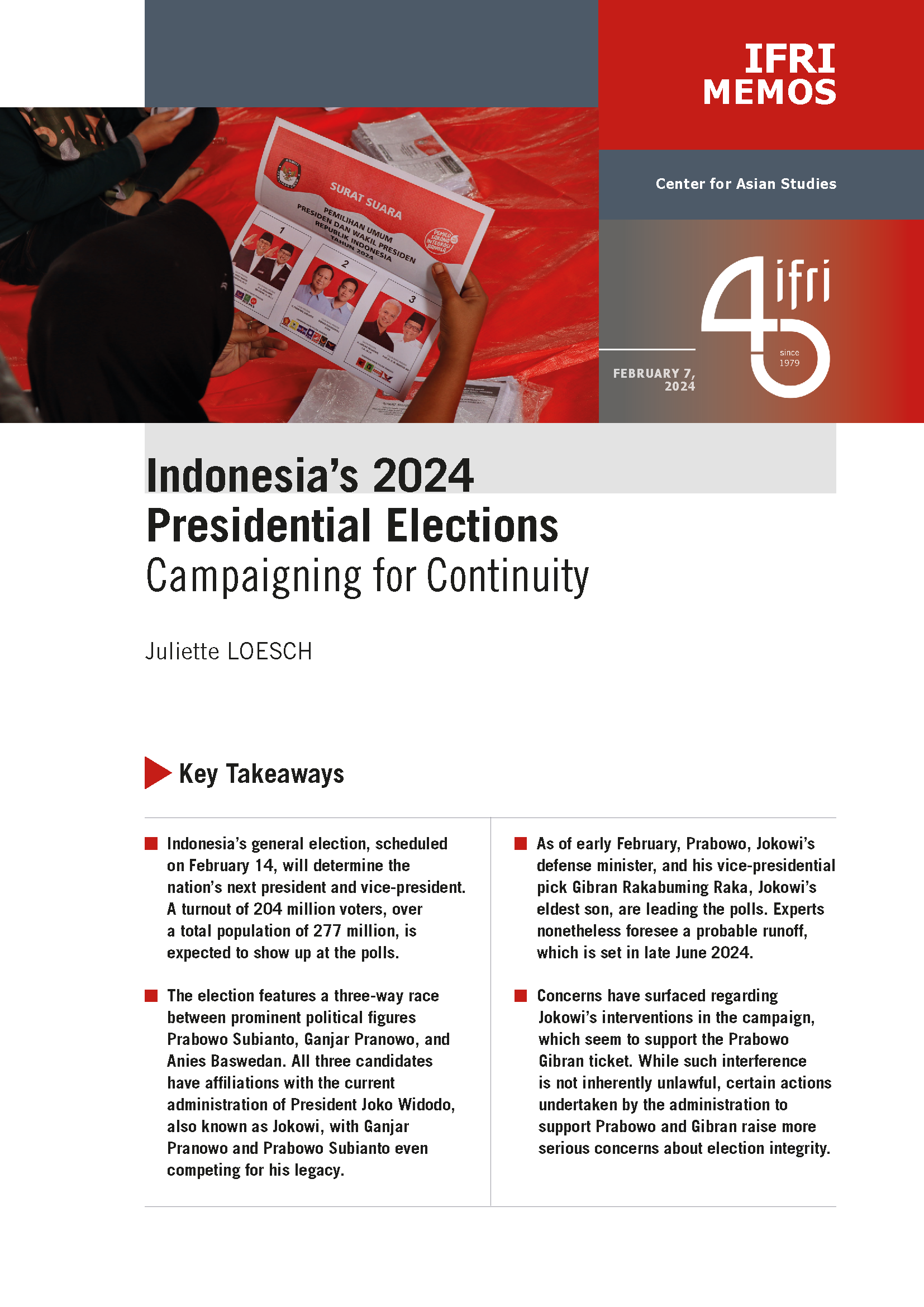
Indonesia is gearing up for its next general election on February 14, with a potential runoff scheduled in late June. This major electoral process will determine the nation’s next president and vice-president since incumbent President Joko Widodo, also known as Jokowi, will step down after ten years in office in compliance with the constitutional limit of two terms.
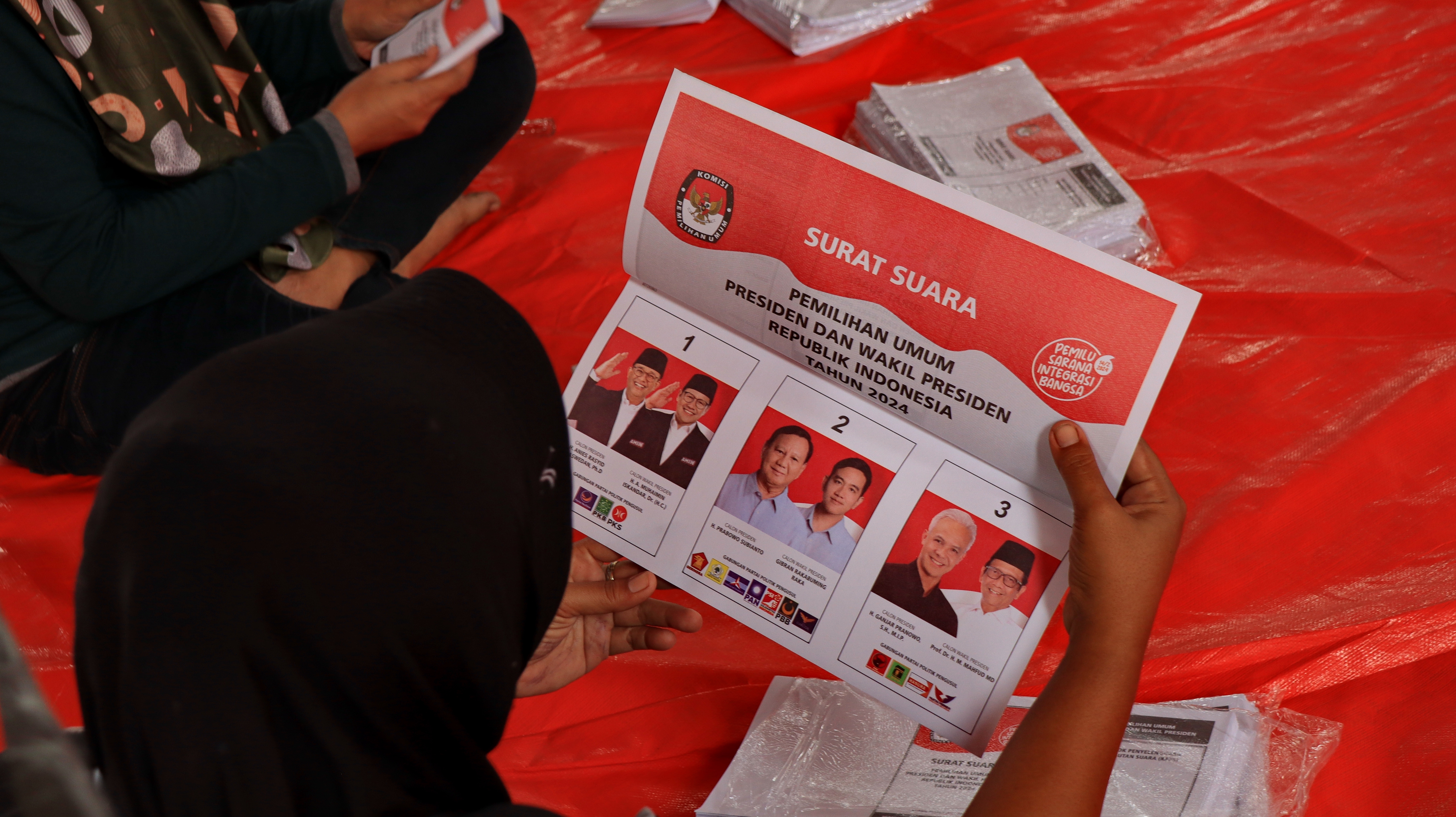
Voters will also decide on nearly 20,000 representatives at the national, provincial, and district levels. Another provincial election is set for November this year, although discussions are currently unfolding in the Parliament to advance it to September. This proposed timeline has triggered concerns about possible interference from the current administration, given that the new one will only be appointed in October.
Indonesia’s general election will determine the nation’s next president and vice-president. A turnout of 204 million voters, over a total population of 277 million, is expected to show up at the polls.
The election features a three-way race between prominent political figures Prabowo Subianto, Ganjar Pranowo, and Anies Baswedan. All three candidates have affiliations with the current administration of President Joko Widodo, also known as Jokowi, with Ganjar Pranowo and Prabowo Subianto even competing for his legacy.
As of early February, Prabowo, Jokowi’s defense minister, and his vice-presidential pick Gibran Rakabuming Raka, Jokowi’s eldest son, are leading the polls. Experts nonetheless foresee a probable runoff, which is set in late June 2024.
Concerns have surfaced regarding Jokowi’s interventions in the campaign, which seem to support the Prabowo Gibran ticket. While such interference is not inherently unlawful, certain actions undertaken by the administration to support Prabowo and Gibran raise more serious concerns about election integrity.

Available in:
Regions and themes
ISBN / ISSN
Share
This page contains only a summary of our work. If you would like to have access to all the information from our research on the subject, you can download the full version in PDF format.
Indonesia’s 2024 Presidential Elections: Campaigning for Continuity

Center for Asian Studies
Asia is a nerve center for multiple global economic, political and security challenges. The Center for Asian Studies provides documented expertise and a platform for discussion on Asian issues to accompany decision makers and explain and contextualize developments in the region for the sake of a larger public dialogue.
The Center's research is organized along two major axes: relations between Asia's major powers and the rest of the world; and internal economic and social dynamics of Asian countries. The Center's research focuses primarily on China, Japan, India, Taiwan and the Indo-Pacific, but also covers Southeast Asia, the Korean peninsula and the Pacific Islands.
The Centre for Asian Studies maintains close institutional links with counterpart research institutes in Europe and Asia, and its researchers regularly carry out fieldwork in the region.
The Center organizes closed-door roundtables, expert-level seminars and a number of public events, including an Annual Conference, that welcome experts from Asia, Europe and the United States. The work of Center’s researchers, as well as that of their partners, is regularly published in the Center’s electronic journal Asie.Visions.

China’s Climate Leadership after Hormuz: How Should Europe Adjust?
The effective closure of the Strait of Hormuz in early 2026 offered an unplanned stress test of China’s approach to energy security, and China passed it far better than most expected. The episode demonstrated that the underlying risk of supply disruption is real, while validating a preference for resilience and resource security that has long underpinned Chinese energy and climate policy and has now been reinforced under the banner of building an “energy powerhouse.”

China as an ambivalent supporter of the WTO and the multilateral trading system
Amid rising trade tensions between Europe and China and broader uncertainty in the international rules-based trade regime, Beijing has worked to preserve and bolster the multilateral trading system while at the same time failing to reform the domestic policies that have served to undermine that same system.

Canada in the Indo-Pacific Sustaining the Pivot, Partnering with France
Since the launch of Canada’s inaugural Indo-Pacific Strategy (IPS) in November 2022, Ottawa has moved—with notable but uneven momentum—from the margins of regional engagement to a position of growing strategic visibility. The Strategy, backed by an initial $2.3 billion five-year investment, reflects a long-overdue recognition: Canada is a Pacific nation whose prosperity and security are inextricably linked to the stability of the world’s most economically and strategically consequential region.

Pakistan and the Israel-Palestine Conflict: Transformation in Pakistan’s Approach After the War in Gaza
Pakistan has long combined vocal support for the Palestinian cause with covert engagement with Israel. Since the war in Gaza, this balance has become untenable: public opinion is united against Israel, joining Trump’s Board of Peace has drawn rare cross-party criticism, and new regional alignments put normalization out of reach.