


Russia’s Afghan Policy in the Regional and Russia-West Contexts
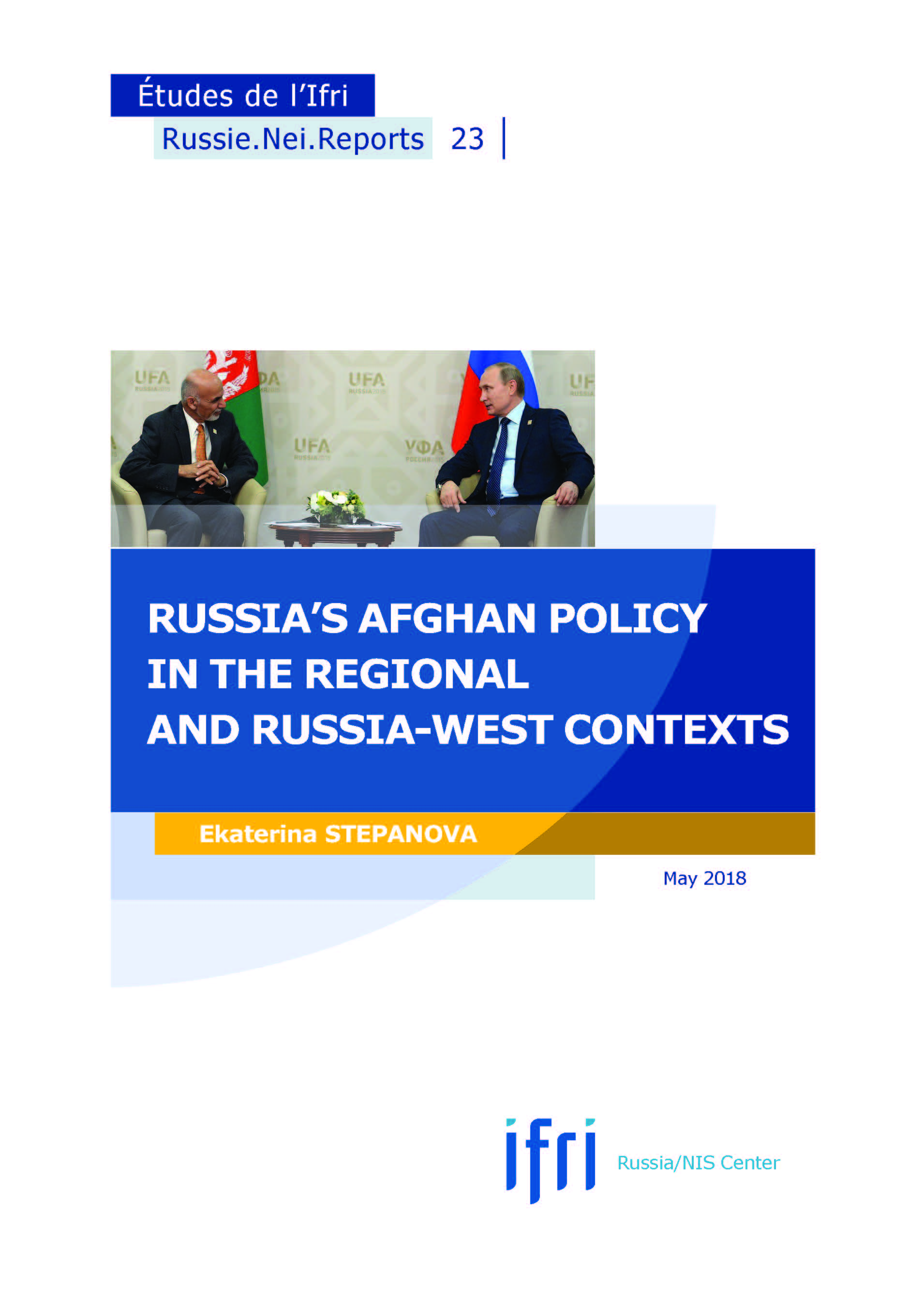
This report seeks to explain the main trends in Russia’s evolving Afghanistan policy, with the focus on its regionalization, diversification, and new emphasis on diplomacy that culminated in Moscow regional peace consultations. It argues that none of Russia’s Afghanistan-related concerns can be alleviated as long as the armed conflict there continues in full force. This makes Moscow genuinely interested in stabilization.
However, the mere combination of military pressure against the Taliban and Western support of the Afghan government cannot achieve stabilization. As Russia remains severely constrained on any hard-security track and has limited leverage inside Afghanistan, there is little it can do apart from pushing for a regionally inclusive political process and supporting, within its capacity, anti-Islamic State of Iraq and Syria (ISIS) efforts at national, regional and international levels. Both tasks require access to all major regional players, including even limited communication channels with the Taliban. The report explores the effects of the evolving US/NATO factor on Russia’s policy and Moscow’s reaction to the revised US policy on Afghanistan under President Trump. Finally, it looks at how Afghanistan features in the rarely addressed Russia-Europe/EU context and whether there is any potential for cooperation or parallel efforts with similar or compatible goals.
Ekaterina Stepanova heads the Peace and Conflict Studies Unit at the Primakov National Research Institute of the World Economy and International Relations (IMEMO), Moscow.
This page contains only a summary of our work. If you would like to have access to all the information from our research on the subject, you can download the full version in PDF format.
Russia’s Afghan Policy in the Regional and Russia-West Contexts


Russia/Eurasia Center
Founded in 2005 within Ifri, the Russia/Eurasia Center conducts research and organizes debates on Russia, Eastern Europe, Central Asia, and the South Caucasus. Its goal is to understand and anticipate the evolution of this complex and rapidly changing geographical area in order to enrich public discourse in France and Europe and to assist in strategic, political, and economic decision-making.

China in Kyrgyzstan and Tajikistan: From Economic Presence to a New Security Role
Over the past three decades, China’s influence in Central Asia has steadily expanded, but in the last three to five years this process has entered a markedly accelerated phase. Following 2022, Beijing effectively revised both its strategy and its operational approach toward the region.

Between Russia and Europe, between War and Peace: What is at Stake in Armenia’s Upcoming Elections?
Armenia’s June 7, 2026, parliamentary election is shaping up less as a routine vote than as a referendum on Nikol Pashinyan’s post-2020 course, which includes peace with neighbors, reduced dependence on Russia, and a more explicit European orientation. The ruling Civil Contract party is still the frontrunner, but its position is fragile, as the campaign is being fought in a highly polarized environment shaped by the trauma of defeat in the war against Azerbaijan, the displacement of Karabakh Armenians, and the massive election interference from Russia.

Russia, the Palestinians and Gaza: Adjustments after October 7th
The Soviet Union (USSR), and subsequently the Russian Federation as its internationally recognized legal successor, has consistently sought to play a visible role in efforts to resolve the Israeli-Palestinian conflict.

Deathonomics: The Social, Political, and Economic Costs of War in Russia
The report attempts to outline and examine a truly new phenomenon in Russian society, dubbed “deathonomics”—the making of a mercenary army against the backdrop of the Kremlin’s war in Ukraine, eventually replacing both the Soviet (conscript) and early new Russian (contract) armies. It notes that, by the end of 2023, this trend had turned the military service into one of the highest-paying professions in the country, something not seen in Russia on such a scale since the late 17th century.