
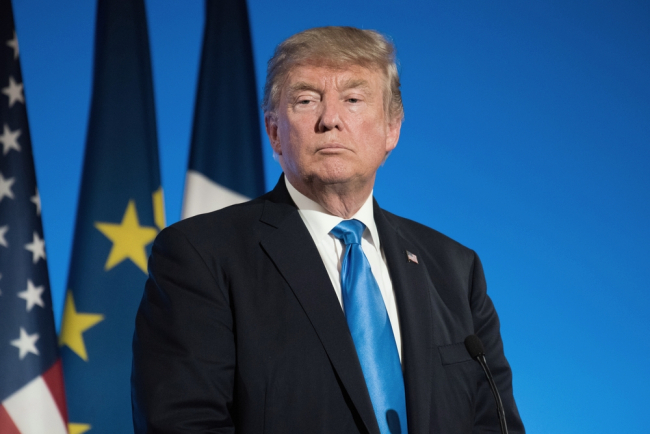
Trump, un an après. Un monde à l'état de nature ?
In the week following Trump’s election, Ifri published a study to identify the likely changes in U.S. foreign policy. From the outset, this election appeared as a change in the U.S.’ trajectory, with consequences on the power relations and functioning of the international system.
Donald Trump's challenge to American democracy and the western alliance
On April 27, 2017, Ifri hosted David FRUM (former speechwriter for President George W. Bush, senior editor for The Atlantic magazine) to discuss Donald Trump's challenge to American democracy and the western alliance.
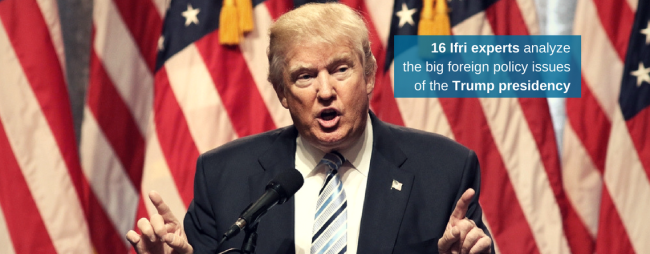
Le monde selon Trump. Anticiper la nouvelle politique étrangère américaine
What will become of US foreign policy under Donald Trump? A selection of Ifri researchers has come together to offer their thoughts on this question. Our experts cover an array of topics through 14 contributions, ranging from the future Sino-American relations, through US engagement in the Middle East, to the prospects of a renewed transatlantic relationship. This analysis intends to help readers anticipate the outcomes of this election in order to facilitate decision-making.
Hillary Clinton et le leadership américain
Hillary Clinton, the frontrunner in the U.S. presidential election, has plans for American foreign policy. Clinton wants ISIS and Bashar Al-Assad out of Syria and to focus on human rights in trade negotiations with China. Now, Clinton and her campaign hope that voters will believe in her vision and her ability to make it happen.
The Middle East that Awaits a New US Administration
Along with a history marked by intervention from external powers, the Middle East is now confronting conflicts which combine political, ethnic and religious dimensions. The United States can not withdraw its “leadership” in the area. Aside from the Syrian question, the next American administration will have to redefine the network of partnerships and alliances in the region and grapple with a multitude of problems, none of which have simple solutions.
Après Paris et San Bernardino, le terrorisme dans le débat américain
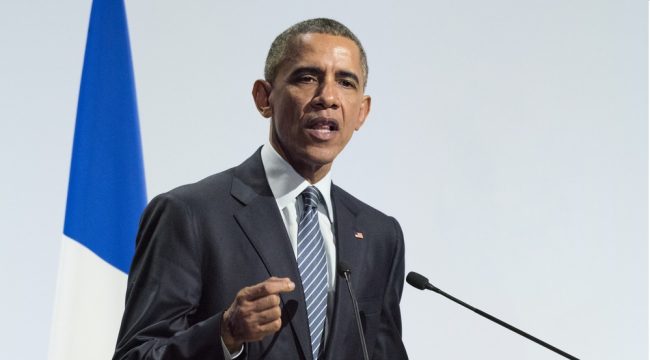
Both the Paris attacks and the San Bernardino shooting reopened the wound of terrorism in the United States. Although President Obama has not shifted his stance or his strategy on the issue, public opinion is worried and populist rhetoric is ever more present in the campaign for the 2016 election.
Can Washington move beyond "Ukraine fatigue"?
For the past two years, the United States has been at grips with an increasingly revisionist Russia in continental Europe. The crisis in Ukraine deteriorated the state of the bilateral relationship with Moscow [1] to what could be an all-time low since the end of the Cold War [2].
U.S. Engagement Towards Central Asia: No Great Game After All?
Since the collapse of the Soviet Union in the 1990s, Washington has defined general foreign policy objectives towards the Republics of Kazakhstan, Kyrgyzstan, Tajikistan, Turkmenistan, and Uzbekistan.
Homeland : une série de l'ère Obama
Once widely praised as one of the best shows on television, Homeland will be back for a fourth season starting next week. The show was originally intended as a breaking point with the one-sided and trigger-happy foreign policy of the Bush administration. However, Homeland is sadly turning out to be the reflection of Obama’s foreign policy, itself rather disappointing up to now. What will the new episodes tell us?
Accountability: "Missing In Action"
Accountability is on the endangered species list. No - not the word. Indeed, “accountability” reverberates around the electronic ether almost as frequently as “thwarking.” It is the reality of persons, especially public persons, taking responsibility for acts of malfeasance in ways that entail exemplary punishment and personal costs.
Global Swing States and U.S. Strategy
Defending and renewing the global order is a priority for the United States and Europe. An important part of this effort will be accomplished if transatlantic partners can successfully engage four “global swing states” — Brazil, India, Indonesia and Turkey — in the management of global issues, because of their geopolitical and economic status, as well as their desire to have a stronger voice in the various international forums. Successful engagement of these nations will be key to preserving the international order and U.S. leadership.
Obama's Second Term: The Process of Building Global Leadership
The second term of Barack Obama’s presidency has introduced new Foreign Policy leadership that suggests changes for the future. The White House will likely centralize foreign policy making and the Treasury Department may play a bigger role in the country’s global engagement. Despite new policy direction, no framework for the strategic renewal of U.S. global leadership has emerged.
Les républicains et la politique étrangère américaine: quelles perspectives pour 2016 ?
The future candidates for the 2016 Republican presidential primary will be expected to develop a clear foreign policy agenda and prove the GOP’s credibility on foreign affairs issue.
The Future of the American Leadership: Between Renewal and Delegation
In an effort to preserve its global leadership, the United States has engaged in a “double rebalancing”; a geopolitical rebalancing, as illustrated by the “pivot to Asia,” and a rebalancing of means, with the Obama administration increasingly advancing diplomatic and economic negotiations (economic statecraft), emphasizing the indirect uses of military force and opening up reinforced dialogue with new actors.
The Obama Administration and Syria: From "off the table" to on
A quick look at the news dealing with the Syrian uprising the last year shows a slow progression from protests and civil resistance towards violence. The Obama Administration’s policy dealing with what many have called “slow motion revolution” has evolved in fits and starts, with mixed episodes of confusion, assertiveness, denial and drift.
One Year Before the Election: Countdown to a Second Term?
Ifri's December conferences have become a staple event for Europeans eager to understand the evolutions underway in the United States. For our tenth edition, we discussed the main specificities of the U.S. judiciary system and their impact on non-U.S. citizens and entities, the up-coming presidential elections, the economic situation of a country caught between the debt and a recession, and finally, the evolution of U.S. attitudes vis-a-vis the upheavals in the Arab and Muslim World.
U.S. Foreign Policy and the Israeli-Palestinian Conflict: A View from Palestine
How will the US respond to the changing Palestinian and Arab paradigm?
Beyond the Midterms: The Outlook for the Obama Administration
One month after the midterm elections, it was time to step back and reflect upon the state of affairs at the time and future direction of President Obama’s Administration and deal with which campaign promises might be achieved in the remaining years and how the political parties would rally for the 2012 elections.
Ifri, a foundation recognized as being of public utility, relies largely on private donors – companies and individuals – to guarantee its sustainability and intellectual independence. Through their funding, donors help maintain the Institute's position among the world's leading think tanks. By benefiting from an internationally recognized network and expertise, donors refine their understanding of geopolitical risk and its consequences on global politics and the economy. In 2026, Ifri partners with over 90 French and international companies and organizations.