3391 publications
The Western Balkans : a touchstone for German and European foreign policy
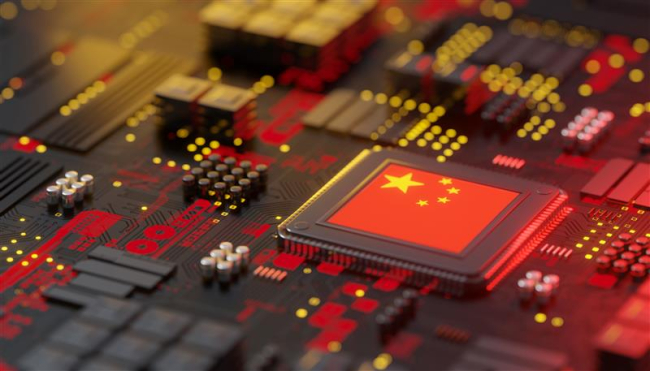
China’s rise: the view from South Korea
Monitoring China-South Korea relations is key for the EU, as both countries have been designated strategic partners. Moreover, the Union has important economic ties to both, and signed a free trade agreement (FTA) with the Republic of Korea (ROK) in 2011.
États-Unis : La Cour suprême en balance
The first few months of this year have been eventful and dramatic for legal and judicial matters on either sides of the Atlantic: while France renewed a third of its magistrates - which has gone largely unnoticed - US Supreme Court Justice Antonin Scalia's sudden death caused a political earthquake.
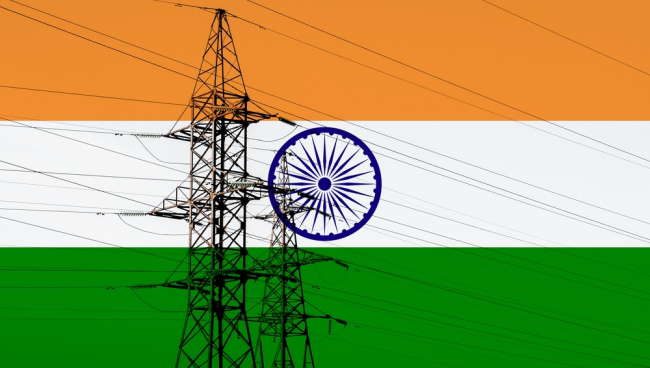
The European Union : When the Commission and Governments put the Future of Electricity Producers at Stake
RWE, EON, EDF, ENGIE and other large utilities are in financial turmoil. This situation, which would have been unlikely twenty years ago, is related to several failures in governance within the EU as well as to global evolutions. This Edito Energie analyses the situation of large European electricity producers in light of the European energy policy.
The faded star of President Mohamed Ould Abdel Aziz
The Mauritanian President, Mohamed Ould Abdel Aziz, was elected in 2009. The architect of two successful coups: in 2005 against President Maaouya Ould Sid’Ahmed Taya, and in 2008 against President Sidi Ould Cheikh Abdellahi, nowadays he is in his second and last term of office according to the Mauritanian constitution. He is viewed by the country's partners as one of the key figures in the stability of the Sahel. However, the international community does not see, or pretends not to see, the weakening of his regime.
Russia's Diplomacy in the Middle East: Back to Geopolitics
Moscow's approach to the Middle East has undergone real changes from Soviet times to the present day: it evolved from creating zones of influence against the background of confrontation with the West to seeing the region through the prism of mainly economic interests, and, finally, to Moscow’s current pragmatic view.
Retours sur Sangaris. Entre stabilisation et protection des civils
In December 2013, France launched its operation Sangaris in the Central African Republic. What conclusions can be drawn for the stabilization of the country and the protection of civilians?
CETA: the Making of the Comprehensive Economic and Trade Agreement Between Canada and the EU
Once ratified, the Comprehensive and Economic Trade Agreement (CETA) could ultimately eliminate all tariff barriers between the European Union and Canada. CETA is also a new generation Free-Trade Agreement: it includes the opening of public procurement, the facilitation of cross investments and cooperation in the area of regulation. Its long negotiation process illustrated important changes that are happening in the way trade agreements are negotiated, both in Canada and in the EU.
Najib Razak’s Malaysia: A solid economy on a foundation of political tension
Najib Razak began his term as Prime Minister of Malaysia in 2009 amidst a severe global economic crisis, concern over spiraling public debt and fears the country would fall into the ominous “middle income trap”.
Reflections on 17 years of UN presence in the Democratic Republic of Congo
Since 2013 and the victory of the Congolese armed forces and the United Nations over the last serious threat against the regime - the 23 March (M23) movement-, the question of the relevance of the UN presence in the Democratic Republic of Congo (DRC) is raised again.
Citizenship in the French Tradition. Values and Realities
Citizenship is a major issue in public debates when it comes to immigration in France. Passionate talks illustrate the current disagreements on the meaning of value such as “laïcité”, “universalism”, “equality”, “community” and on the way these should apply in social and political life.
Présidentielles 2016: le Parti républicain et la politique étrangère
Three Republican presidential candidates have proposed a foreign policy agenda worthy of examination. Marco Rubio (who withdrew from the race on 15 March 2016) and Ted Cruz present well-defined political projects pertaining to different traditions of American foreign policy theory. Donald Trump’s approach is less clear-cut but also less traditional, between isolationism and profitability.
The European Union in the Fog: Building Bridges between National Perspectives on the European Union
The Building Bridges project looks at the national perspectives on the European Union. This publication gathers contributions from across the EU. It sheds light on Member States’ motivations to participate in the EU and views on its future. Accessible and analytical, this volume is an ideal reference guide for practitioners, experts, students and European citizens.
The US Electricity Industry and the Low-Carbon Transition
Transitioning to a low-carbon, decentralized and digitalized electricity system requires setting out new roles for incumbent suppliers, new entrants and consumers now generating their own power. Where is the US electricity industry heading and what does it say about market designs for the 21st century electricity system?
The Last-ditch Attempt to Build the Energy Union
Nearly one year after the presentation of the Energy Union project, while 2016 promises to be a critical year for its implementation, what is the status of this flagship project of the Juncker Commission?
The Return of Geopolitical Risk - Russia, China and the United States
The year 2014 was defined by the conflict in Ukraine, the emergence of Daesh, and tensions between China and Japan. As for 2015, it has witnessed the spread of Daesh, the conflict in Yemen, the Greek crisis, revelations about the activity of the National Security Agency (NSA), the migrant crisis, and a ramping-up of terrorist attacks.
La sécurité énergétique des armées françaises. Le soutien pétrolier à l’heure de la transition
Ever since its inception on the eve of World War One, the concept of securing fuel supply has consistently proven its vitality to military operations.
Humanitarian exploit or failure? The refugee crisis in Germany and Europe
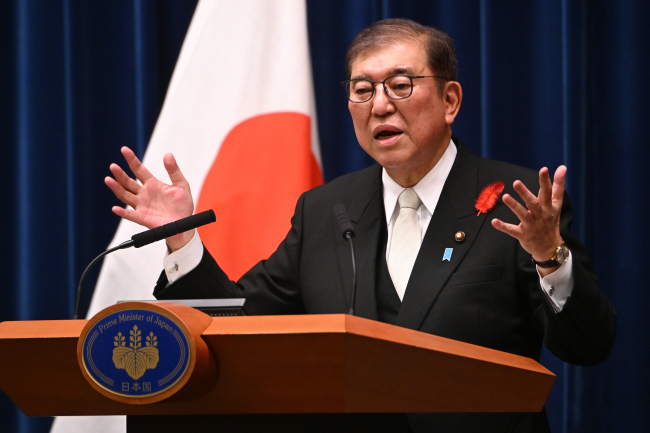
Determinants of Japan’s ODA Allocation in Africa
The debate on emerging donors raises a question whether traditional donors really follow their own ODA (Official Development Assistance) policies or not. This paper addresses the question by investigating Japan’s adherence to its own ODA policies.
The Illusion of Convergence—Russia, China, and the BRICS
The discussion about the BRICS (Brazil, Russia, India, China, and South Africa) opposes two narratives. The first considers they play an increasing role in the international relations as the West is loosing power; the other sees the BRICS as a charade. But the key role played by the interaction between Russia and China is an evidence shared by most experts.
Tokyo face aux désastres naturels : leçons, enjeux et défis
While Tokyo prepares to welcome the 2020 Summer Olympic Games, the likelihood that a massive earthquake will occur in the capital city within the next thirty years is estimated at 70 %. This fact alone reflects the challenges that Japan must face in managing the risk of natural disasters.
Sustainable Electrification for Asia and Africa
Complementary solutions to national grid extensions let hope for significant improvements in the field of energy access, consistent with current economic and environmental challenges. This Note explores the regulatory and economic prerequisites that must be enhanced in order to support the emergence of mini-grid and off-grid technologies.
Migrations in Africa: Another Look
Migration in Africa is a major concern, but largely for Africans alone. To adequately study the question of international migration, one must look beyond Europe’s current predicament. Through its dossier on “Migrations in Africa: Another Look”, this issue of Politique étrangère examines a number of factors that determine migration movements, how states in Africa attempt to manage the significant problem of internal migration, the difficulties of integrating migrant workers into their host societies, and the false pretenses of Euro-African agreements on readmission.
Brexit: The Risks of Referendum
The British Prime Minister has announced that a referendum will be held to decide whether the UK will remain in the European Union. David Cameron’s announcement has prompted analysis of the risks it would pose for the balance among UK political parties, for British cohesion, and for the future of the European project. In England, the rise of euroscepticism and nationalist sentiment is real. The possibility of a “Brexit” should not be ignored.
Understanding African Migrations
Movements of African people, being within their countries, on the continent or heading Europe, have numerous and ancient causes. The term “migration” covers a plurality of situations with many internal as well as international implications. Therefore, reasons to migrate deserve a careful analysis. One cannot tackle such a phenomenon through mere border control policies or their externalization, as the European Union seems inclined to do.
From the German Question to the European Question
Are we returning to “The German Question”, which we thought had been dealt with at unification? Although “The German Question” has deep historical roots, its return is indicative of a European crisis: economic fractures, institutions in deadlock, relative withdrawal of France and the UK on serious Union debates. Only through increased European integration can we expect Germany to regain to a place which it can occupy comfortably.
Kurds against IS: An Effective Military Solution?
The Kurdish military’s recent history immediately brings to mind images of its mythical female fighters, and of its real victories against Daesh. But its successes have been primarily in Syria. In Iraq, the Kurdish military has been hindered by poor preparation, lack of effective weaponry, and various political and tactical disagreements between actors. Without support from the West, Kurdish forces will not be able to win the on-ground offensive.
Malta: No Bridge is "A Bridge Too Far"
Malta as an isolated country saw relations with the EU as a bridge building effort with the peoples of the European Continent, which would also secure supplies, open markets, help obtain energy and strengthen security.
France: Disenchantment in Slow Motion
In France, Europe basically expresses four objectives: peace, parity with Germany, economic development, and leveraging French power. But today, the feeling abounds that none of these objectives are really being achieved.
Lithuania: A Case of Confidence in the European Project
If Lithuania did not enter the EU with specific objectives in mind, it has clearly benefited from its membership. Membership has allowed the country to catch up economically, to join the Single Market and expand business opportunities. Its adoption of the euro in the midst of the Eurozone crisis is another evidence of Lithuanian keenness to participate actively to the EU.
United Kingdom: Still the Odd Man Out?
For Britain, the perceptions of its membership of the EU is seen in transactional terms. Joining and remaining in the EU was always sold as an economic decision taken for economic reasons. Therefore, concepts like “political union” mean very little in the UK. Even the idea of the EU being a “project” has little echo.
Latvia: Supporting the Right Cause and Deepening the Economic and Monetary Union
Latvia’s benefits to the EU have been clear. It has boosted the modernisation of the country and its infrastructures via the Cohesion Funds. It has helped reconnect the country with the West. And it has served to provide security to Latvia, especially vis-à-vis Russia.
Germany: Being European in a Renationalising Europe
The times when the German population met the EU with almost unconditional and passive support might be over, but it is still convinced that any step backwards would entrain even bigger damages for Germany’s stability, peace and wealth.
Bulgaria: The Spectre of a Two-Speed Europe
One of Bulgaria’s paradoxes is that 25 years after the collapse of communism and almost ten years of EU membership, it seems to be quite unhappy with the transition but rather happy with its EU membership. In this way, the EU continues to be a beacon outside rather than the reality inside the country.
Croatia: An Expanding Learning Curve
The expectations of Croat citizens are modest since the country entered the EU in the midst of the financial crisis and the popular feeling is one of cautious optimism. The membership serves as a catalyst for the creation of national identity as one rooted in the West. It should also boost growth in the country, which Croatia is only starting to see having entered the EU in the midst of the crisis.
Cyprus: A Divided Island Coping with the Financial Crisis
Both politically and economically, Cyprus retains mixed feelings toward the benefits of its EU membership. The country remains divided in two parts despite the “European solution”, which should have solved the situation. The economic crisis has also left a bitter taste in the mouths of Cypriots, especially considering the events that led to the bail-in programme. Overall, the experience has disillusioned the population.
Denmark: A Pragmatic Euroscepticism
The Danes are generally happy with the EU’s level of economic integration and are proponents of furthering the integration of the single market. However, they are sceptical when it comes to the EU’s federal trimmings and EU process standards in social and employment policies.
Luxembourg: Being Determines (European) Consciousness
A key element to understand the Luxembourgish perspective on the EU relates to its geography. Contacts with citizens from neighbouring countries are daily and affect the kind of society that Luxembourg has become, quite multinational. Similarly, the presence of many international companies leads Luxembourg to favour open markets for labour, services, goods and capital.
Portugal: Waiting for Better in the Adversity
The Portuguese population remains supportive of the EU, but without a clear motive, and with a feeling that the country is run by external actors with external interests. Meanwhile, the authorities have strived to appear as “a good student” rigorously implementing austerity measures.
Slovakia: Country of Many Paradoxes
Slovakia might be perceived as a “latecomer” in preparing for EU accession only in the 1990s, but it caught up rapidly. Among its chief objectives was for Slovakians to achieve higher living standards and gain an external system of checks and balances, which would improve the country’s democratic processes and public administration.