


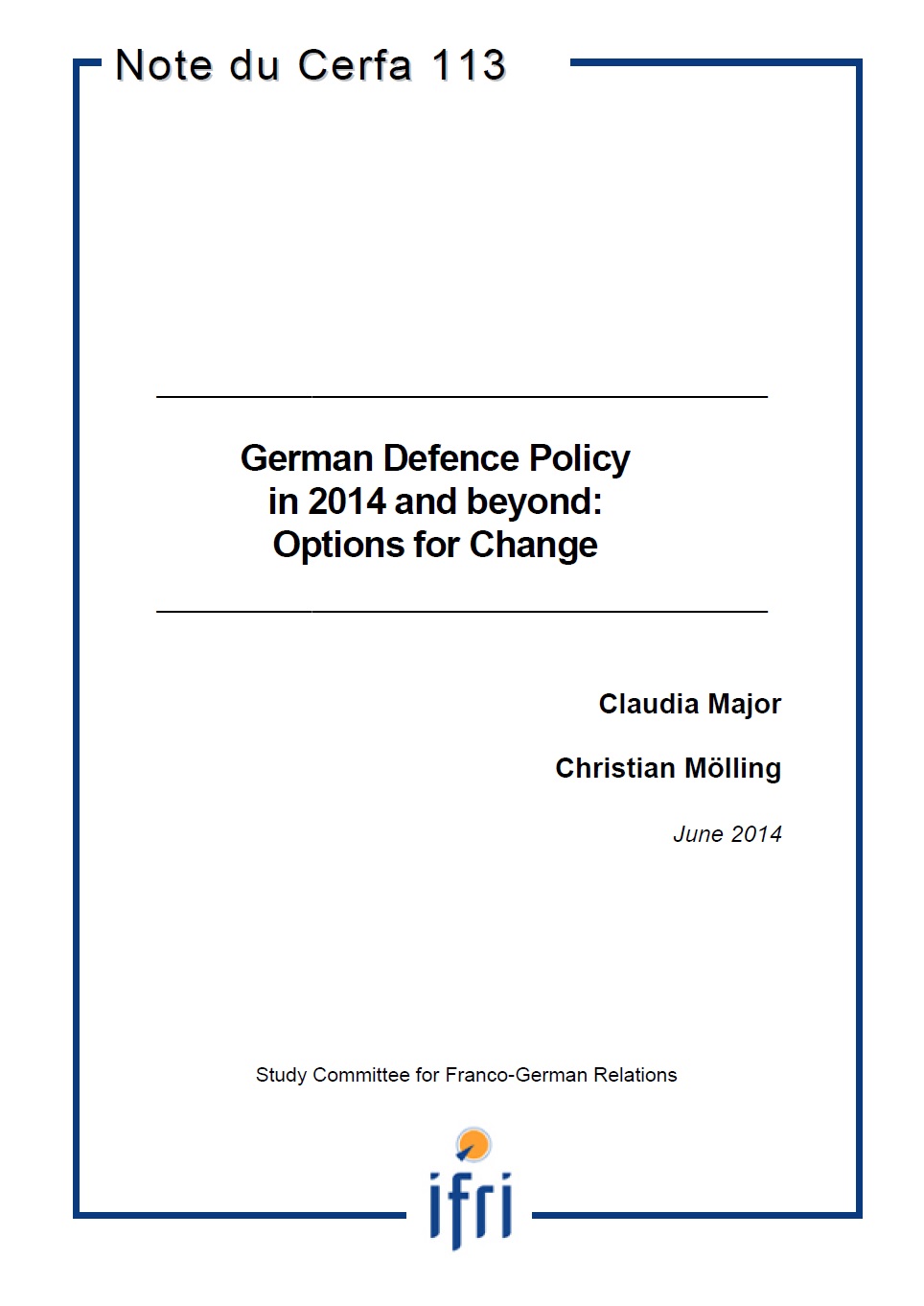
German Defence Policy in 2014 and beyond: Options for Change
The speeches made by several German leaders at the Munich Security Conference in early 2014, emphasized that Germany needs to be ready for greater international commitment, and without a priori excluding military instruments.
While several elements seem to indicate growing awareness that change is needed, the nature of German contributions – especially in Africa – shows the long road ahead. A basic contradiction persists between the government’s rhetoric that Germany should participate in international operations and the political limitation on its contributions toward training, advisory functions and logistical support. Apart from political support at the highest level, increased responsibility needs also to be supported by public opinion, which still lacks enthusiasm for what it often perceives as militarism. Similarly, German defence export policy is torn between the government’s willingness to support industry in exporting and the negative feedback about these exports from the public. Change may occur as a result of external developments, linked to NATO or the defence industry, but these impulses need to be taken up by national debate. It remains to be seen whether or not the direction taken will coincide with that outlined in Munich. The crisis in Ukraine must also be taken into account: it could have a catalytic effect, increasing Germany’s visibility and engagement in NATO. Through this crisis, Germany is under pressure to intensify its engagement.
Claudia Major is deputy head of the Research Division “International security policy” at the German Institute for International and Security Affairs (Stiftung Wissenschaft und Politik).
Christian Mölling is Research associate at the German Institute for International and Security Affairs (Stiftung Wissenschaft und Politik).
Available in:
Regions and themes
ISBN / ISSN
Share
Download the full analysis
This page contains only a summary of our work. If you would like to have access to all the information from our research on the subject, you can download the full version in PDF format.
German Defence Policy in 2014 and beyond: Options for Change
Author(s)
Related centers and programs
Discover our other research centers and programs
The Study Committee on Franco-German Relations (Cerfa)
The Study Committee on Franco-German Relations (Cerfa) was created in 1954 by an inter-governmental agreement between the Federal Republic of Germany and France, in order to raise awareness of Germany in France and analyze Franco-German relations, including in their European and international dimensions. In its conferences and seminars, which bring together experts, political leaders, senior decision-makers and representatives of civil society from both countries, Cerfa develops the Franco-German debate and stimulates political proposals. It regularly publishes studies through two collections: Cerfa notes and studies as well as Franco-German visions.
Cerfa maintains close relations with the network of German foundations and think tanks. In addition to its research and debate activities, Cerfa promotes the emergence of a new Franco-German generation through original cooperation programs. This is how in 2021-2022, Cerfa led a program on multilateralism with the Konrad Adenauer Foundation in Paris. This program is aimed at young professionals from both countries interested in the issues of multilateralism in the context of their activities. It covered a wide range of themes relating to multilateralism, such as international trade, health, human rights and migration, non-proliferation and disarmament. Previously, Cerfa had participated in the Franco-German future dialogue, co-led with the DGAP from 2007 to 2020, and supported by the Robert Bosch Foundation and the Daniel Vernet group (formerly the Franco-German Reflection Group) which was founded in 2014 upon the initiative of the Genshagen Foundation.
Find out more
Discover all our analyses
Reviving the German Economy: Balancing Economic, Social, and Defense Priorities
Germany is facing fundamental challenges to its economic and social model and is seeking a new course. The German post-war model was hugely successful, leading to economic strength and prosperity over many decades, but now it is steadily faltering. The previously latent fear of deindustrialization is becoming more concrete, particularly due to the weakening of a key sector: the automotive industry.

Entry into force of the EU-Mercosur agreement: last act of an endless drama for Germany?
At the World Economic Forum in Davos on January 20, 2026, Ursula von der Leyen, the President of the European Commission, stated that "geopolitical shocks can and must serve as opportunity for Europe".

German-Indian Relations: a Partnership based on values or on interests?
In recent years, virtually no other Asian country has seen such a rise in prominence in German foreign policy as India.

The 2026 State Elections in Baden-Württemberg: First Test For Chancellor Merz's Federal Government?
The state election in Baden-Wuerttemberg in March 2026 will be the first major test of public opinion for Chancellor Friedrich Merz's federal government. At the same time, Baden-Wuerttemberg is one of the federal states that—as an important location for the German automotive industry and its suppliers—is particularly affected by the transformation policy driven by climate change and the international conflict constellation.